


“The First Amendment and Public Meetings: Knowing Your Rights in Limited Public Forums"
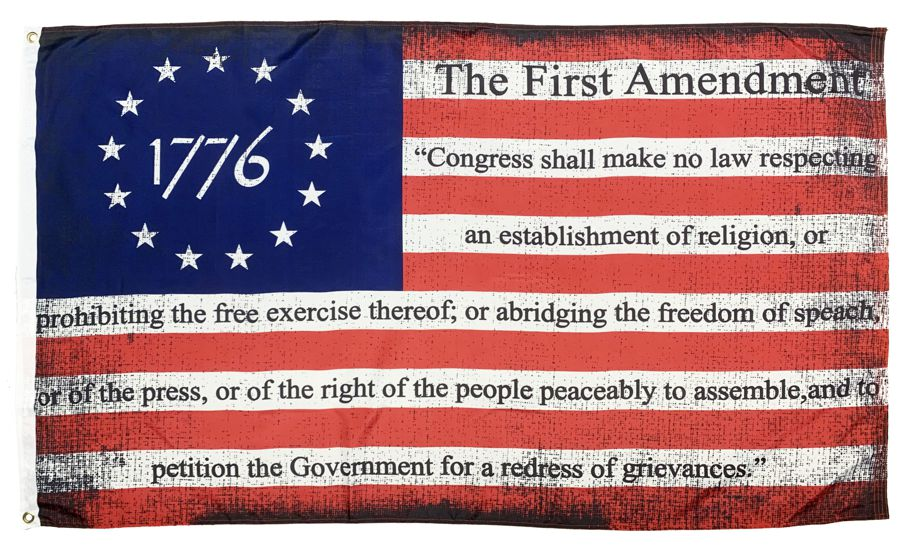
“Congress shall make no law respecting an establishment of religion, or prohibiting the
free exercise thereof; or abridging the freedom of speech, or of the press; or the right of
the people peaceably to assemble, and to petition the Government for a redress of
grievances.” So reads the First Amendment of the United States Constitution, an
integral component of our nation’s foundation, ratified in 1791. Guaranteeing the rights
of our citizens to freedom of speech, religious expression, and freedom of the press is a
critical construct of our nation. But are there limitations to the first amendment? And, if
so, what do they look like?
After Tuesday night’s lively town council meeting in Hanna, this topic deserves attention
and clarification. (A quick note regarding last night’s council meeting: no arrests were
made, no citations issued, and any parties asked to leave did so amiably of their own
accord.)
Amendment 1.7.7.1 of the United States Constitution classifies public forums in three
separate designations. The first designation is commonly called a “traditional public
forum,” which includes places such as streets or parks that have traditionally been
utilized for public assemblies, debates, protests, etc. In this specific forum, the
government may impose “reasonable time, place, and manner restrictions…”
Restrictions based on opinions are prohibited, and any type of content-based restriction
is subject to extremely strict scrutiny (Minn. Voters All., slip op. at 11. See
also Summum, 555 U.S. at 469–70.)
The second category of public forum is known as a designated public forum, or “limited
public forum.” This type of forum is typically conducted by a certain group(s) or utilized
to discuss specific subjects. A town council meeting is an example of a limited public
forum. Certain governmental limitations may be imposed on these forums, but content-
based prohibition once again must be closely scrutinized and narrowly classified (Perry
Educ. Ass’n v. Perry Local Educators’ Ass’n, 460 U.S. 37, 45, 46 n.7 (1983.) What this
essentially means is that the government can regulate the time, place, and manner of
speech, to an extent. However, any regulation of the content of the speech must be
“narrowly drawn to effectuate a compelling state interest” (Id at 46.)
In the state of Wyoming, regulation of these limited public forums falls under Wyoming
State Statute 16-4-406: Disruption of Public Meetings. This statute states that “If any
public meeting is willfully disrupted by a person or group of persons so as to render the
orderly conduct of the meeting unfeasible…the governing body of an agency may order
the removal of the person or group or persons from the meeting room and continue in
session...” With this construct, the state of Wyoming, acting under the First Amendment,
ensures that public meetings can be conducted in an orderly fashion and not disrupted
to the extent of prohibiting appropriate conduction.
The last type of forum categorized by Amendment 1.7.7.1 is known as a “nonpublic
forum,” or the utilization of a space that is not “by tradition or designation a forum for
public communication” Minn. Voters All., slip op. at 7 (quoting Perry Educ. Ass’n, 460
U.S. at 46).
The importance of councils, forums, and public meetings cannot be understated. These
mechanisms are what allow us to progress as a society and a community, ensuring that
everyone has a voice in the process. However, under the First Amendment of the
United States Constitution, certain governmental limitations may be imposed to ensure
the orderly function and conduction of these meetings.
As always, thank you for reading! If you have any questions, please find us on
Facebook at Alex Bakken-Carbon County Sheriff, or email at ccsheriff.com.
Other sources not cited in text: constitution.congress.gov.
Sheriff Alex Bakken.

Comments