


Colorado Wolf Reintroduction: What it Means for Carbon County
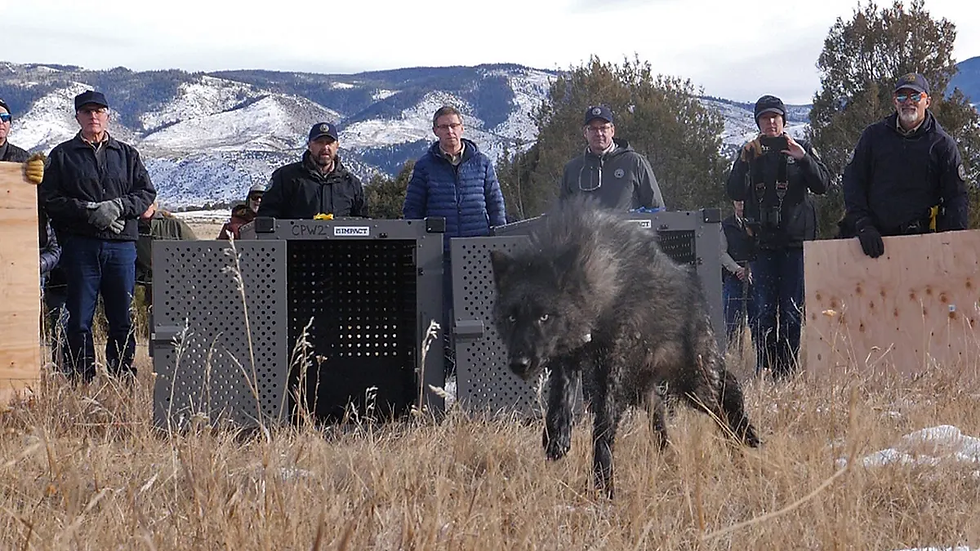
As most residents of Carbon County are undoubtedly aware, our neighbors to the south have officially implemented their gray wolf reintroduction plan. Officials with Colorado Parks and Wildlife have recently released a total of five (5) wolves in Grand County, west of Rocky Mountain National Park. The five wolves released consist of two (2) juvenile females, two (2) juvenile males, and one (1) adult male. The goal, according to the Colorado Parks and Wildlife, is to release ten (10) to fifteen (15) wolves by March of 2024 and thirty (30) to fifty (50) wolves over the next three to five years. Grand County, for those who are aware, is a short drive from Carbon County and the state line, being bordered on the north by Moffat County and Routt County.
While we can spend countless hours pondering the questionable wisdom of ballot-driven biology, and the frustrations of wolf reintroduction in counties that largely voted against it, our focus should be on what happens next, specifically in the state of Wyoming and the county of Carbon.

Gray wolf management in Wyoming is comprised of several different segments and corresponding mechanisms. For example, the Wyoming Game and Fish Commission has management authority for gray wolves in areas of the state where wolves are designated as “trophy game animals.” These areas exclude gray wolves that live on the National Elk Refuge or those that are present on lands governed by the National Park Service within Grand Teton National Park. Furthermore, the Commission does not have any management authority over gray wolves in Yellowstone National Park or any tribal lands within the Wind River Reservation. Wolves that occupy the lands outside Yellowstone National Park and the Wind River Reservation are governed under the management objectives of the Commission as listed in Section 4, Chapter 21 of the Wyoming Game and Fish Commission.
Contrary to views that erroneously portray Wyoming as an advocate for wolf eradication, the state Game and Fish Commission manages for at least ten (10) breeding pairs of gray wolves and a total of at least one hundred (100) individual gray wolves in Wyoming outside of Yellowstone National Park and the Wind River Reservation. This means that some areas of the state, such as those surrounding Yellowstone National Park, classify wolves as a “Trophy Game Animal” and implement regulatory hunting seasons.
For those portions of the state that fall outside of the “Wolf Trophy Game Management Areas” (and Yellowstone National Park/Wind River Reservation,) wolves are considered a predatory animal as defined under Wyoming Statute 23-1-101 (a)(viii). This includes Carbon County.
Wolf hunting in Carbon County is governed primarily under W.S. 23-1-101 (a)(viii) “Definitions of Animals” and the Wyoming Game and Fish Commission, Chapter 47 “Gray Wolf Hunting Seasons,” Section 8 “Take of Wolves Designated as Predatory Animals.”
In layman terms, the process of hunting and taking wolves in Carbon County is relatively simple and straightforward. Since they are classified as predatory animals under W.S. 23-1-101 (a)(viii,) they are subject to the hunting regulations listed under W.S. 23-3-103 “Taking predatory animals, predacious birds and trophy animals, taking furbearing animals and game birds without license prohibited.” Section (a) of this statute states that “Predatory animals…may be taken without a license and in any manner and at any time except as provided by W.S. 23-2-203 (d) and (e), 23-3-112, 23-3-304 (b), 23-3-305, 23-3-306 (b) and 23-3-307.” This means that gray wolves in Carbon County are not protected by any season or mortality limit regulations and may be taken at any time.
After taking a wolf in Carbon County, hunters are subject to the reporting requirements under Section 8, Chapter 47 of the Wyoming Game and Fish Commission, which are relatively straightforward. This section simply requires that any person taking a gray wolf designated as a predatory animal “…shall be required to report the kill to a district game warden, district wildlife biologist, or Department personnel…within ten (10) days after the date the gray wolf was killed.” Information required by the Wyoming Game and Fish in the reporting requirements include name and address of hunter, date of gray wolf kill, sex of gray wolf, and location of kill site (section, range and township, or UTM coordinates.) In addition, per subsection (b) of Section 8, any electronic radio tracking device is required to be surrendered to the Wyoming Game and Fish Department.
As this curious initiative unfolds, we will likely see the effect of this ballot-driven biology adventure. Thus, it is imperative that we as citizens of Carbon County and the state of Wyoming are aware of our rights and legal obligations regarding the hunting and taking of gray wolves. If you choose to hunt wolves in Carbon County, please ensure you follow all local and state laws.
For more information, please contact your local Game and Fish Warden or Regional Office.
Thank you, and happy hunting.
Sheriff Alex S. Bakken.
Comments